© 2026 Anoushka BadolaAll rights reserved.

01:27:41 PM

Shaping Planetary Futures

image
image

Shaping Planetary Futures

image
image

Shaping Planetary Futures

image
image

Shaping Planetary Futures

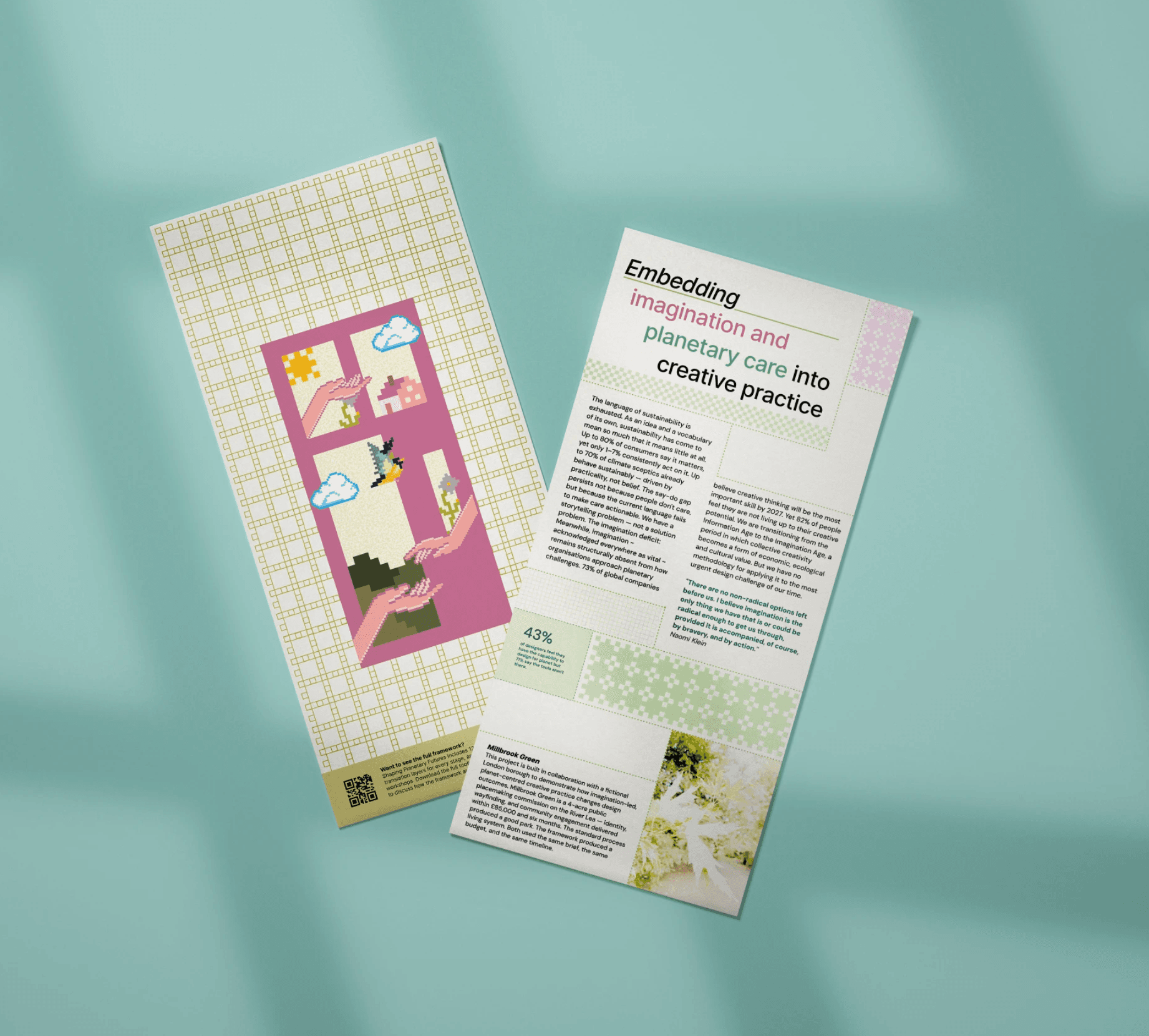
Shaping Planetary Futures is a framework for embedding planetary care and speculative thinking into creative practice from the earliest stages, not as a compliance layer added at the end, but as a structured, repeatable capability that shapes how designers, strategists, and communicators approach every brief. The framework responds to a double failure. Sustainability language is exhausted: up to 80% of consumers say it matters, yet only 1–7% consistently act on it. The current vocabulary isn't moving people. At the same time, imagination is widely acknowledged as the most important skill for the decade ahead. It remains structurally absent from how organisations approach planetary challenges. The tools exist for compliance. What's missing is a methodology that makes imagination and planetary empathy operational. Shaping Planetary Futures provides that methodology. Built across two interconnected layers: five principles that define the mindset and six phases that define the process - the framework positions speculative thinking as its conceptual core. It asks practitioners to imagine futures worth building before designing for the present, to give non-human stakeholders a voice in the process, and to translate framework insights back into the language of the brief through structured action cards. It runs alongside existing design processes, not instead of them.

Shaping Planetary Futures is a framework for embedding planetary care and speculative thinking into creative practice from the earliest stages, not as a compliance layer added at the end, but as a structured, repeatable capability that shapes how designers, strategists, and communicators approach every brief. The framework responds to a double failure. Sustainability language is exhausted: up to 80% of consumers say it matters, yet only 1–7% consistently act on it. The current vocabulary isn't moving people. At the same time, imagination is widely acknowledged as the most important skill for the decade ahead. It remains structurally absent from how organisations approach planetary challenges. The tools exist for compliance. What's missing is a methodology that makes imagination and planetary empathy operational. Shaping Planetary Futures provides that methodology. Built across two interconnected layers: five principles that define the mindset and six phases that define the process - the framework positions speculative thinking as its conceptual core. It asks practitioners to imagine futures worth building before designing for the present, to give non-human stakeholders a voice in the process, and to translate framework insights back into the language of the brief through structured action cards. It runs alongside existing design processes, not instead of them.

Category

Creative Strategy / Design for the Planet / Art Direction

Creative Strategy / Design for the Planet / Art Direction

Time line

Aug 2025 - Nov 2025

Aug 2025 - Nov 2025

image

To test the framework against a realistic brief, I developed Millbrook Green: a fictional placemaking commission for a 4-acre site on the River Lea in east London - identity, wayfinding, and community engagement delivered within £85,000 and six months. The project walks the same brief through two processes: the standard design approach, and the same brief with the framework applied alongside it. The standard process produced a good park. The framework expanded the stakeholder map to include five non-human entities, rewrote the design brief on behalf of the river, redesigned a hard-edged promenade into a graduated wetland margin based on the river's own testimony, and shifted the launch narrative from 'your new community park' to 'a living system you belong to, alongside everything else that lives here.'